Best cameras for weddings
UPDATED OCTOBER 2026Weddings punish slow autofocus and single card slots. These bodies focus reliably in dim churches and receptions, can record every frame to two cards at once, and stay quiet when they need to.
How we ranked them: autofocus in dim light, two card slots for a backup, stabilization, full-frame low-light quality, from manufacturer specs and lab measurements, plus our overall score. How CameraFits makes money
Who this is for
Working wedding photographers and serious enthusiasts who cover full days of ceremonies, portraits and receptions. The job mixes slow, posed work with moments that happen once, often in dark rooms where flash is not welcome.
What matters most
Autofocus in dim light comes first. Makers rate how dark a scene can get before focus gives up, measured in EV. A lower negative number means focus holds in darker rooms. Every camera here is rated to at least −6 EV, and the Z6 III, Zf and Z5 II reach −10 EV.
Two card slots matter because cards fail. With two slots, the camera can write every frame to both cards at once, so one bad card does not cost the couple their ceremony. Every camera here has two slots.
Stabilization lets a photographer use slower shutter speeds handheld at a dim reception, which keeps ISO lower and files cleaner. The R1, R5 II and R6 III are rated at 8.5 stops, and the Z5 II at 7.5. A full-frame sensor adds to that, gathering more light than smaller formats at the high ISO settings receptions demand.
How these picks differ
The picks come from Canon, Nikon and Panasonic. Resolution varies. The R5 II has 45MP for heavy cropping and large prints, the R6 III sits at 32.5MP, and the R6 II, Z6 III and Zf sit around 24MP, which keeps files manageable over a long day.
Sensor speed varies too. The R1, Z6 III and S1 II have stacked or partially stacked sensors with fast measured readout, so the silent electronic shutter bends moving subjects less. The Zf and Z5 II are slower and simpler but still cover the basics. The R1 weighs 1,115g, while the R6 II weighs 670g. For couples who also want a film, the R1, R5 II, R6 III, Z6 III and S1 II all record 4K at 120p.
Buying advice
Budget for lenses before a pricier body. A 24–70mm f/2.8 and a 70–200mm f/2.8 cover most of a wedding, and an 85mm f/1.4 or f/1.8 prime helps in the darkest rooms. Buy fast cards for both slots and set the camera to record to both. Carry at least three batteries, since the Z6 III, Zf, Z5 II and S1 II are all rated under 400 shots per charge. If a second shooter works alongside, matching systems makes sharing lenses and batteries easy. Skip paying extra for 8K or very high burst rates unless they will get used; a wedding rarely needs them.
The 8 picks
- 1
 BEST OVERALLCanon EOS R19.6Best for: Busy pros who want maximum speed and battery life
The R1 is built for sports, but its strengths carry over to weddings. Autofocus is rated to −7.5 EV, and its stacked sensor has a measured readout of 8.3 ms, faster than the Z6 III's 9.4 ms, so silent shooting barely distorts motion. It has two CFexpress B slots of the same type for backup and 8.5-stop stabilization. Battery life is rated at 1,130 shots, roughly double the R5 II's 540, which means fewer swaps during a long day. The 9.44M-dot, 0.9x viewfinder is large and detailed.
The trade-off is size. At 1,115g it is far heavier than the 746g R5 II, and that adds up over ten hours with a 70–200mm lens attached. Its 24.2MP sensor allows less cropping than the R5 II, and CFexpress-only slots mean pricier cards. Its 40fps burst is more than most weddings need. The R5 II gives more resolution in a much lighter body.
- 24.2MP full-frame sensor
- 40 fps burst
- 6K video, 4K 120p
- 8.5-stop stabilization
- 2
 Best for: Canon shooters who want room to crop and deliver large prints
The R5 II pairs a 45MP stacked sensor with autofocus rated to −6.5 EV. That combination lets a photographer frame wide during the ceremony and still crop to a tight portrait later. It records to a CFexpress B card and an SD card at the same time for backup, and its 8.5-stop stabilization helps hold slow shutter speeds at the reception. The 5.76M-dot viewfinder makes focus easy to check, and 8K or 4K 120p video covers couples who want a short film as well.
The cost of 45MP is file size. A full wedding fills cards and hard drives faster than a 24MP body does, and the mixed slots mean buying two card types. Battery life is rated at 540 shots, so spares are still needed. Photographers who rarely crop can use the 32.5MP R6 III, which is a little lighter and has the same card setup.
- 45MP full-frame sensor
- 30 fps burst
- 8K video, 4K 120p
- 8.5-stop stabilization
- 3Canon EOS R39.5
- 24.1MP full-frame sensor
- 30 fps burst
- 6K video, 4K 120p
- 8-stop stabilization
- 4
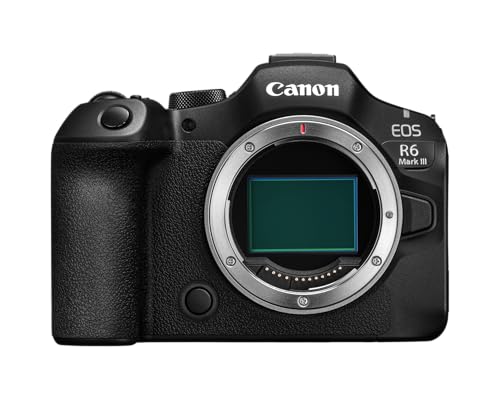 Best for: Hybrid Canon shooters who want more resolution than 24MP
The R6 III sits between the 24MP bodies and the 45MP R5 II. Its 32.5MP sensor gives useful room to crop without huge files. Autofocus is rated to −6.5 EV, stabilization to 8.5 stops, and it records to CFexpress B and SD cards for backup. Its measured readout of 14.3 ms is quicker than the R6 II's, and video reaches 7K with internal Canon RAW, open gate and 4K 120p. That suits couples who want a film from the same body. It weighs 699g.
Battery life is rated at 510 shots, and the 3.69M-dot viewfinder is less detailed than the R5 II's. Mixed slots mean buying two card types. Its readout is still well behind the R1 and Z6 III, so fast motion can bend with the silent shutter. Photographers who want two identical SD slots and a lighter body can use the R6 II, and those who crop heavily should look at the R5 II.
- 32.5MP full-frame sensor
- 40 fps burst
- 7K video, 4K 120p
- 8.5-stop stabilization
- 5
 BEST VALUENikon Z6 III9.3Best for: Nikon shooters who want fast, silent shooting in dark venues
The Z6 III has autofocus rated to −10 EV, a lower figure than the R5 II's −6.5 EV, and shared with the Zf and Z5 II. Its partially stacked sensor has a measured readout of 9.4 ms, so the silent electronic shutter can be used during vows with little distortion of moving hands or a walking couple. It writes to CFexpress B and SD cards for backup, has 8-stop stabilization, and its 5.76M-dot viewfinder stays clear in dim rooms. Video reaches 6K with internal N-RAW.
At 760g it is heavier than the Canon R6 bodies, and battery life is rated at only 390 shots, so three or four spares make sense for a full day. Its 24.5MP sensor leaves less room to crop than the 45MP R5 II, and its dynamic range trails some rivals. Nikon users on a tighter budget get the same −10 EV rating and two SD slots in the Z5 II.
- 24.5MP full-frame sensor
- 60 fps burst
- 6K video, 4K 120p
- 8-stop stabilization
- 6
- 32.5MP full-frame sensor
- 40 fps burst
- 7K video, 4K 120p
- 7.5-stop stabilization
- 7
 Best for: Canon shooters who want a light, proven low-light body
At 670g, the R6 II is light for a full-frame body, which matters at hour ten of a wedding. Its 24.2MP full-frame sensor stays clean at ISO 12,800, and autofocus is rated to −6.5 EV, so dim receptions are not a problem. Two SD UHS-II slots take the same affordable cards for backup, 8-stop stabilization helps with slow handheld shots, and 4K 60p video uses the full sensor width. Battery life is rated at 580 shots, more than the R5 II's 540.
It is an older design than the R6 III, released in 2022. The 3.69M-dot viewfinder is less detailed than the Z6 III's, video is limited to 4K, and the HDMI port is micro-size. Its measured readout of 16.5 ms is slower than the stacked bodies, so the electronic shutter can bend fast motion. The R6 III adds 32.5MP, 4K 120p and a CFexpress slot.
- 24.2MP full-frame sensor
- 40 fps burst
- 4K video, 4K 60p
- 8-stop stabilization
- 8

- 44.3MP full-frame sensor
- 40 fps burst
- 8K video, 4K 120p
- 8-stop stabilization
$2,998See price at Amazon