Best cameras under $1,500
UPDATED OCTOBER 2026The strongest bodies you can buy for $1,500 or less, at today's prices. Body only; add a lens with Build a kit on each camera's page.
How we ranked them: overall image quality, speed, video and stabilization, price, from manufacturer specs and lab measurements, plus our overall score. How CameraFits makes money
Who this is for
Buyers who want one capable interchangeable-lens camera for travel, family, street and video without paying for a professional body. The list is body only, so it suits people who already own lenses or plan to choose one carefully alongside the camera.
What matters most
The ranking weighs overall image quality, speed, video and stabilization against price. Sensor size drives image quality. Full-frame sensors gather more light, which means cleaner files at high ISO and shallower depth of field. APS-C sits in the middle, and Micro Four Thirds trades some low-light quality for smaller lenses. In-body stabilization steadies any lens you mount, which helps with slow shutter speeds indoors and with handheld video. The Canon EOS R8, Fujifilm X-T30 III and Fujifilm X-M5 have none. For video, watch for crop: some bodies cut in at 4K 60p, which makes wide shots harder. A viewfinder helps in bright sun, and weather sealing matters for travel in rain or dust.
How these picks differ
The Nikon Z5 IIc, Canon EOS R8 and Panasonic Lumix S9 are full frame, all around 24MP. The Nikon Z5 IIc is weather sealed with 7.5 stops of stabilization. The R8 shoots up to 40 fps but no in-body stabilization. The S9 is more video-focused and lighter than the Z5 IIc, but has no viewfinder. The Sony A6700 and the Fujifilm X-S20, X-T30 III and X-M5 are APS-C. The A6700 adds insect detection and 4K 120p, and the X-S20 is rated for 750 shots per charge, plus 7 stops of stabilization. The X-T30 III and X-M5 are lighter and simpler than the X-S20, with no in-body stabilization; the X-M5 also has no viewfinder. The OM System OM-5 II uses a Micro Four Thirds sensor. It is small, sealed and well stabilized, but behind the A6700 on video and autofocus features.
Buying advice
Budget for a lens from the start. A good standard zoom or a fast prime shapes results more than the body does. Full-frame lenses are usually larger and cost more, so factor that in before choosing full frame over APS-C. If you shoot handheld video or in low light without a tripod, favor a body with in-body stabilization. If you travel in bad weather, check sealing: the X-S20, S9, X-T30 III and X-M5 are not sealed. Buy at least one spare battery for cameras rated near 300 shots. Skip open-gate and raw video features unless you edit video seriously.
The 8 picks
- 1BEST OVERALLNikon Z5 IIc8.6Best for: Buyers who want a sealed full-frame body with in-body stabilization
The Z5 IIc combines a 24.5MP full-frame sensor with 7.5 stops of in-body stabilization and weather sealing, a mix the Canon EOS R8 and Panasonic Lumix S9 do not offer. Native ISO reaches 64,000 and autofocus is rated down to -10 EV, so it handles dim rooms and evening light well. It shoots up to 30 fps. For video it records internal N-RAW and N-Log, which leaves room for color grading, and it has both mic and headphone jacks.
Its 4K 60p mode uses a 1.5x crop, so wide shots at that frame rate are harder. It records to a single SD card, battery life is rated at 350 shots, and at 620 g it is heavier than the Canon EOS R8. Buyers who mostly want fast bursts in a lighter body should look at the R8, and video-first buyers should compare the Panasonic Lumix S9.
- 24.5MP full-frame sensor
- 30 fps burst
- 4K video, 4K 60p
- 7.5-stop stabilization
- 2
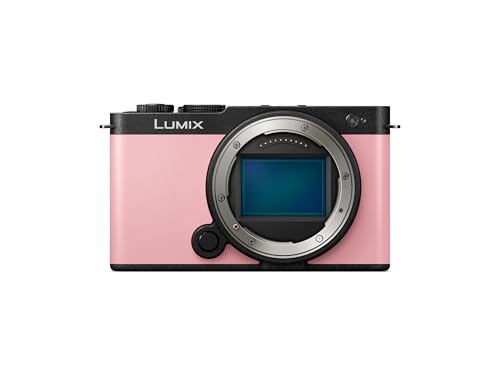 Best for: Video creators who want full frame in a compact body
The Lumix S9 puts a 24.2MP full-frame sensor in a 486 g body, and it is built around video. It records up to 6K 30p, supports open-gate capture so one clip can be cropped to both vertical and horizontal formats, and shoots 10-bit V-Log. In-body stabilization is rated at 6.5 stops, autofocus detects people and animals, and native ISO reaches 51,200.
It has no viewfinder, so framing in bright sun relies on the fully articulating screen. The shutter is electronic only, with a measured readout of 22 ms, which can bend fast-moving subjects. 4K 60p is cropped 1.5x, it has a mic jack but no headphone jack, and it is not weather sealed. Stills shooters who want a viewfinder and sealing should choose the Nikon Z5 IIc. Buyers who want a small hybrid with longer battery life should look at the Fujifilm X-S20.
- 24.2MP full-frame sensor
- 30 fps burst
- 6K video, 4K 60p
- 6.5-stop stabilization
- 3
 Best for: Hybrid shooters who want APS-C, stabilization and long battery life
The X-S20 pairs a 26.1MP APS-C sensor with 7 stops of in-body stabilization, and its battery is rated at 750 shots, more than the Sony A6700's 570. Video is a strength: it records up to 6.2K 30p with open gate and 10-bit F-Log and F-Log2, and it has both mic and headphone jacks. Autofocus detects people, animals, birds and vehicles down to -7 EV. At 491 g it is easy to carry all day, and the fully articulating screen suits vlogging.
It is not weather sealed and has a single SD slot. The 2.36M-dot viewfinder is basic, the mechanical shutter tops out at 1/4000 s, and native ISO stops at 12,800, so very low light is better handled by the full-frame bodies. Buyers who need sealing should choose the Sony A6700, which also adds 4K 120p.
- 26.1MP APS-C sensor
- 30 fps burst
- 6K video, 4K 60p
- 7-stop stabilization
- 4
 Best for: Hikers and travelers who want a small, sealed, stabilized camera
The OM-5 II uses a Micro Four Thirds sensor and is built to be carried. At 418 g with weather sealing and 7.5 stops of in-body stabilization, it suits hiking and travel in poor weather. The smaller sensor means smaller, lighter lenses for the same framing, a real gain at telephoto lengths. It shoots up to 30 fps, and its measured readout of 10 ms is faster than the Sony A6700's 15.9 ms, which limits distortion with the electronic shutter.
The trade-offs are clear. Its 20.4MP sensor has less resolution than the 26MP Sony A6700 and shows noise sooner at high ISO than full-frame bodies such as the Nikon Z5 IIc. Autofocus detection is listed for people only, with no animal or vehicle tracking. Video is limited to 4K 30p in 8-bit, it has a mic jack but no headphone jack, and battery life is rated at 310 shots. Buyers who want stronger tracking and video in a small, sealed body should choose the Sony A6700.
- 20.4MP Micro Four Thirds sensor
- 30 fps burst
- 4K video, 4K 30p
- 7.5-stop stabilization
- 5
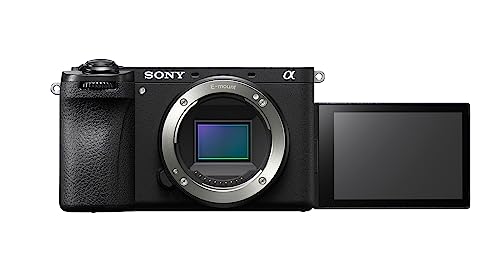 Sony A67007.3Best for: Sony shooters who want tracking, 4K 120p and weather sealing
The A6700's subject detection covers people, animals, birds, insects and vehicles, a wider list than the Fujifilm X-S20's, which suits pets, garden birds and youth sports. Video reaches 4K 120p with no crop at 4K 60p, in 10-bit S-Log3, and it has mic and headphone jacks. It is weather sealed, has 5 stops of in-body stabilization, and its battery is rated at 570 shots. The 26MP APS-C sensor and 493 g body keep it compact.
Its top burst rate is 11 fps, far slower than the Canon EOS R8's 40 fps, and autofocus is rated only to -3 EV, less sensitive in very dim light than the X-S20's -7 EV. Stabilization is weaker than on the Fujifilm X-S20 or OM System OM-5 II, and it has a single SD slot. Buyers who want faster bursts and a full-frame sensor should look at the Canon EOS R8.
- 26MP APS-C sensor
- 11 fps burst
- 4K video, 4K 120p
- 5-stop stabilization
- 6
- 20.4MP Micro Four Thirds sensor
- 30 fps burst
- 4K video, 4K 30p
- 5.5-stop stabilization
- 7
- 20.4MP Micro Four Thirds sensor
- 30 fps burst
- 5.6K video, 4K 120p
- 508 g
- 8
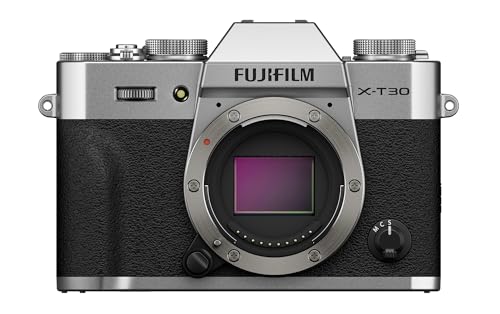 BEST VALUEBest for: Stills shooters who want a light Fujifilm with a viewfinder
The X-T30 III fits a 26.1MP APS-C sensor and a viewfinder into a 378 g body, lighter than the Fujifilm X-S20. Autofocus detects people, animals, birds and vehicles down to -7 EV, and it shoots up to 30 fps. Video reaches 6.2K 30p with open gate and F-Log2, and 12-bit raw video can be sent over HDMI. It suits street and travel photography, where a small camera gets carried more often.
It has no in-body stabilization, so slow shutter speeds and handheld video depend on stabilized lenses. It is not weather sealed, its single card slot is UHS-I, battery life is rated at 315 shots, and the screen tilts rather than fully articulating. 4K 60p is cropped 1.18x, and it has a mic jack but no headphone jack. Buyers who want stabilization and longer battery life in a Fujifilm body should choose the Fujifilm X-S20.
- 26.1MP APS-C sensor
- 30 fps burst
- 6K video, 4K 60p
- 378 g