Best cameras under $1,000
UPDATED OCTOBER 2026The strongest bodies you can buy for $1,000 or less, at today's prices. Body only; add a lens with Build a kit on each camera's page.
How we ranked them: overall image quality, speed, video and stabilization, price, from manufacturer specs and lab measurements, plus our overall score. How CameraFits makes money
Who this is for
First-time buyers moving up from a phone, parents, travelers and hobbyists who want a real interchangeable-lens camera on a firm budget. These bodies take far better photos than a phone in dim light and with moving subjects, and they accept lenses that grow with the photographer.
What matters most
Overall image quality comes from the sensor and the lens. All of these cameras use APS-C sensors, from 20.9MP on the Z50 II to 26.1MP on the Fujifilm bodies, which is plenty for prints and cropping. Speed covers burst rate and autofocus. Every body here tracks people and animals, and burst rates span 11fps on the ZV-E10 II to 30fps on the X-T30 III.
Video matters to many buyers at this level. Look at whether a camera can shoot 4K at 60p and how much it crops the frame to do so, since a heavy crop makes wide shots harder. Stabilization is the big gap at this price: none of these bodies has in-body stabilization. That makes a stabilized lens important for low light and handheld video.
Price is the last factor. A cheaper body leaves more of the budget for a better lens, which often improves photos more than a body upgrade.
How these picks differ
The picks come from four systems: Fujifilm with the X-T30 III and X-M5, Nikon with the Z50 II, Canon with the R50, and Sony with the ZV-E10 II. Lens choice and future upgrades depend on that system, so it is worth picking with care.
The X-T30 III, Nikon Z50 II and Canon EOS R50 have an eye-level viewfinder. The X-M5 and Sony ZV-E10 II rely on the rear screen, which suits video and casual shooting but is harder in bright sun.
The X-M5 weighs 355g, while the Z50 II weighs 550g. For video, the X-T30 III and X-M5 record up to 6.2K with open gate, the ZV-E10 II records 4K 60p with only a light crop, and the R50 stops at 4K 30p. Battery life is rated at 230 shots on the Z50 II and 610 on the ZV-E10 II.
Buying advice
Buy the body with a stabilized kit zoom if one is offered, since none of these cameras has in-body stabilization. Add an inexpensive fast prime, such as a 50mm-equivalent f/1.8 or f/2, for portraits and low light. A spare battery and a fast SD card are cheap and worth having. Skip older, discounted bodies with weaker autofocus; modern subject detection makes more difference to keeper rates than a few extra megapixels.
The 8 picks
- 1BEST OVERALL
- 20.4MP Micro Four Thirds sensor
- 30 fps burst
- 4K video, 4K 30p
- 5.5-stop stabilization
- 2
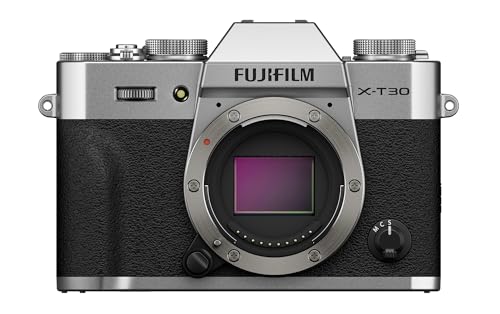 Best for: Photo-first buyers who want a viewfinder and strong video
The X-T30 III balances stills and video well in a small body. Its 26.1MP APS-C BSI sensor matches the X-M5's resolution, autofocus is rated to −7 EV and detects people, animals and vehicles, and burst reaches 30fps. It has a 2.36M-dot eye-level viewfinder and a tilting screen. Video goes up to 6.2K, with open gate and 4K 60p at a 1.18x crop, plus F-Log2 and raw output over HDMI. It weighs a light 378g.
There is no in-body stabilization, so a stabilized lens matters. Battery life is rated at 315 shots, the card slot is the slower UHS-I type, and there is a mic jack but no headphone jack. It is not weather sealed. Buyers who mostly shoot video and don't need a viewfinder can save weight with the X-M5, which adds a headphone jack.
- 26.1MP APS-C sensor
- 30 fps burst
- 6K video, 4K 60p
- 378 g
- 3
 Best for: Travelers and video creators who want a very small body
At 355g, the X-M5 is lighter than the X-T30 III, yet it shares the X-T30 III's 26.1MP APS-C BSI sensor and 30fps burst. Video is a clear strength: it records up to 6.2K with open gate, 4K 60p at a 1.18x crop, F-Log and F-Log2, and 12-bit raw over HDMI. It has both mic and headphone jacks, which the X-T30 III and R50 lack. Autofocus detects people, animals and vehicles.
It has no viewfinder, so all framing happens on the rear screen, which is harder in bright sun and less steady for telephoto shots. There is no in-body stabilization, battery life is rated at 330 shots, and the card slot is UHS-I. It is not weather sealed. Buyers who shoot mostly stills and want an eye-level viewfinder should choose the X-T30 III.
- 26.1MP APS-C sensor
- 30 fps burst
- 6K video, 4K 60p
- 355 g
- 4
 Nikon Z50 II6.2Best for: Nikon buyers who shoot indoors and in low light
The Z50 II has autofocus rated to −9 EV, stronger than the R50's −4 EV, and it detects people, animals and vehicles. Its 2.36M-dot viewfinder has 1.02x magnification, a larger view than the R50's 0.95x, and the fully articulating screen suits both selfies and low angles. Video reaches 4K 60p with N-Log, and it has mic and headphone jacks plus a faster UHS-II card slot. Burst reaches 30fps.
It has trade-offs. Battery life is rated at 230 shots, so a spare battery is essential. At 550g it is heavier than the 378g X-T30 III, and its 20.9MP sensor has less resolution. 4K 60p needs a 1.5x crop, and video is 4:2:0. There is no in-body stabilization. Buyers who want more resolution in a lighter body should look at the X-T30 III.
- 20.9MP APS-C sensor
- 30 fps burst
- 4K video, 4K 60p
- 550 g
- 5BEST VALUE
- 24.2MP APS-C sensor
- 15 fps burst
- 4K video, 4K 60p
- 370 g
- 6
- 20.3MP Micro Four Thirds sensor
- 9 fps burst
- 4K video, 4K 30p
- 5-stop stabilization
- 7
- 20.1MP sensor
- 30 fps burst
- 4K video, 4K 30p
- 304 g
- 8
 Best for: Beginners who want a light, simple Canon with a viewfinder
The R50 is light at 375g and offers an eye-level viewfinder with 0.95x magnification, plus a fully articulating screen. Its 24.2MP APS-C sensor delivers plenty of detail, and autofocus detects people, animals and vehicles. Burst reaches 15fps, and battery life is rated at 440 shots, better than the X-T30 III's 315. Video records 4K 30p in 10-bit.
It is less capable for video than the X-M5. It has no 4K 60p, and audio is mic-only with no headphone jack. Autofocus is rated to −4 EV, so it gives up earlier in dark rooms than the Z50 II. The card slot is UHS-I, and there is no in-body stabilization or weather sealing. Buyers who shoot indoors often, or want 4K 60p, should choose the Z50 II.
- 24.2MP APS-C sensor
- 15 fps burst
- 4K video, 4K 30p
- 375 g