Best wildlife cameras under $2,500
UPDATED OCTOBER 2026Wildlife rewards fast bursts, autofocus that recognises birds and animals, and enough resolution to crop in. Weather sealing helps on long days outside.
How we ranked them: burst speed, bird and animal tracking, resolution to crop, weather sealing, from manufacturer specs and lab measurements, plus our overall score. How CameraFits makes money
Who this is for
Wildlife and bird photographers who want strong tracking and reach without paying for a flagship body. The list mixes two full-frame bodies, three APS-C bodies and three Micro Four Thirds bodies. That sensor-size choice shapes everything else, from lens size to low-light quality. Every body covered is weather sealed.
What matters most
Burst speed gives more frames to choose from when an animal moves. Every camera covered reaches at least 20 fps, and most reach 30 fps or more. Subject tracking keeps the focus point on an eye as the animal turns and moves, and every camera covered detects animals. Resolution decides cropping room. Sensor size changes reach: an APS-C sensor gives the framing of a lens about 1.5 times longer (1.6 times on Canon), and Micro Four Thirds about 2 times longer. A 300mm lens on Micro Four Thirds frames like a 600mm on full frame, so lenses are smaller and lighter for the same reach. The cost is more noise at high ISO, which matters at dawn and dusk when animals are most active. Readout speed affects distortion with the silent electronic shutter; a faster measured readout keeps wings straight.
How these picks differ
The Nikon Z6 III and Canon EOS R6 II are full frame, with the cleanest high-ISO files but less reach from each lens. The Canon EOS R7 (32.5MP) and Fujifilm X-H2 (40.2MP) are APS-C bodies with plenty of resolution for cropping, but slow measured readouts of about 30 ms, so the mechanical shutter is the safer choice for fast action. The Fujifilm X-H2S trades resolution (26.16MP) for a stacked sensor and 40 fps. The OM System OM-1 II and OM-3 share a stacked 20.4MP Micro Four Thirds sensor with 50 fps bursts, and the OM-3's measured readout of 5.8 ms is faster than the X-H2S's 9.7 ms. The Panasonic Lumix G9 II reaches 75 fps, faster than the OM System bodies, and has slightly more resolution than the OM System bodies.
Buying advice
Price the lens before the body. A long telephoto zoom often matters more to results than the camera, and the smaller formats reach far with compact lenses. Check which telephotos your mount offers from both the camera maker and third parties. Plan on two fast cards and at least one spare battery. If you shoot mostly in low light, lean toward full frame. If you hike long distances with a big lens, the smaller systems save real weight. Skip 8K and raw video features unless you will actually use them, and spend the difference on glass.
The 8 picks
- 1
 BEST OVERALLNikon Z6 III9.3Best for: Nikon shooters who want full-frame speed and low-light focus
The Z6 III has a partially stacked full-frame sensor, with a measured readout of 9.4 ms and bursts up to 60 fps. Its autofocus detects animals and birds and is rated to -10 EV, very good in dim light, which matters at first light when animals are most active. The full-frame sensor keeps high-ISO noise lower than on APS-C bodies such as the Canon EOS R7. A bright 5.76M-dot viewfinder, 8 stops of stabilization and a CFexpress B plus SD card pair round it out.
At 24.5MP it offers less cropping room than the 32.5MP Canon EOS R7 or the 40.2MP Fujifilm X-H2, and full-frame telephotos are larger and heavier for the same reach. At 760 g it is also heavier than the Canon EOS R6 II, and battery life is rated at 390 shots. Shooters who want more reach in a lighter kit should look at the OM System OM-1 II.
- 24.5MP full-frame sensor
- 60 fps burst
- 6K video, 4K 120p
- 8-stop stabilization
- 2
 Best for: Canon shooters who work in low light at dawn and dusk
The EOS R6 II is a full-frame body whose 24.2MP sensor stays clean at ISO 12,800, and its native range reaches 102,400. That suits animals that are active in the half-light of early morning and evening. It shoots up to 40 fps, its autofocus detects animals and birds down to -6.5 EV, and stabilization is rated at 8 stops. Battery life is rated at 580 shots, and at 670 g it is lighter than the Nikon Z6 III.
The trade-offs are cropping room and readout. 24.2MP limits how far a distant bird can be cropped, and its measured readout of 16.5 ms is slower than the Z6 III's 9.4 ms, so fast wings can skew with the electronic shutter. It also records to two SD cards with no CFexpress slot, so long bursts take longer to clear. Canon shooters who need more reach should look at the Canon EOS R7.
- 24.2MP full-frame sensor
- 40 fps burst
- 4K video, 4K 60p
- 8-stop stabilization
- 3
 Canon EOS R78.1Best for: Canon shooters who want APS-C reach and resolution for birds
The EOS R7 puts a 32.5MP APS-C sensor in Canon's RF mount. The smaller sensor gives any lens the framing of one about 1.6 times longer, so a 400mm lens frames like a 640mm on full frame, and the 32.5MP files still leave room to crop. It shoots bursts up to 30 fps, detects animals and birds, and has 7 stops of stabilization. Two SD card slots, weather sealing and battery life rated at 660 shots suit long days outdoors, and it weighs 612 g.
Its measured readout of 30 ms is much slower than the Fujifilm X-H2S's 9.7 ms, so the electronic shutter can bend fast wings and panning subjects; the mechanical shutter is safer for action. Autofocus is rated to -5 EV, and high-ISO noise is higher than on the full-frame Canon EOS R6 II. Shooters who want a fast-readout APS-C body should look at the Fujifilm X-H2S.
- 32.5MP APS-C sensor
- 30 fps burst
- 4K video, 4K 60p
- 7-stop stabilization
- 4
 Best for: Hikers who want long reach in a small, sealed kit
The OM-1 II uses a 20.4MP stacked Micro Four Thirds sensor. Its 2x crop factor means a 300mm lens frames like a 600mm on full frame, so a complete long-lens kit stays small enough to carry on long walks. It reaches 50 fps, detects animals and birds, and its autofocus is rated to -8 EV. Stabilization is rated at 8.5 stops, more than the OM-3's 7.5, which helps when shooting long focal lengths handheld. It has a 5.76M-dot viewfinder, weather sealing and two SD card slots, and battery life is rated at 520 shots.
The small sensor has costs. Its 20.4MP gives less cropping room than the 25.2MP Panasonic Lumix G9 II, and noise rises sooner at high ISO than on the full-frame Nikon Z6 III or Canon EOS R6 II. Shooters who work mostly in dim light should choose one of those full-frame bodies instead.
- 20.4MP Micro Four Thirds sensor
- 50 fps burst
- 4K video, 4K 60p
- 8.5-stop stabilization
- 5
 Best for: Shooters who want stacked-sensor speed in a lighter Micro Four Thirds body
The OM-3 shares the 20.4MP stacked sensor of the OM System OM-1 II, with bursts up to 50 fps and autofocus that detects animals and birds down to -8 EV. Its measured readout of 5.8 ms is faster than the Fujifilm X-H2S's 9.7 ms, so the electronic shutter freezes wings and fast movement with little distortion. The 2x crop factor gives long reach from small lenses. At 496 g it is lighter than the 599 g OM-1 II, and battery life is rated at 590 shots. It is weather sealed and has 7.5 stops of stabilization.
It has a single SD card slot, so there is no in-camera backup when a rare sighting happens. Its 2.36M-dot viewfinder is lower resolution than the OM-1 II's 5.76M-dot finder. Like the OM-1 II, its small sensor shows noise sooner at high ISO. Shooters who want dual card slots and a sharper viewfinder should choose the OM System OM-1 II.
- 20.4MP Micro Four Thirds sensor
- 50 fps burst
- 4K video, 4K 60p
- 7.5-stop stabilization
- 6
 Best for: Fujifilm shooters who want maximum resolution for cropping
The X-H2 has a 40.2MP APS-C sensor, more resolution than the 32.5MP Canon EOS R7. Combined with the roughly 1.5x crop factor, that gives plenty of room to crop a distant subject and still keep fine detail in feathers and fur. Autofocus detects animals and birds down to -7 EV, stabilization is rated at 7 stops, and it records to a CFexpress B and an SD card. A 5.76M-dot viewfinder and weather sealing suit long sessions, and battery life is rated at 540 shots.
Speed is the trade-off. Its top burst rate is 20 fps, half the X-H2S's 40 fps, and its measured readout of 30.7 ms is slow, so the electronic shutter can distort fast-moving subjects. It suits perched birds and slower animals better than birds in flight. Fujifilm users who mainly shoot action should choose the Fujifilm X-H2S, which has a stacked sensor and 40 fps.
- 40.2MP APS-C sensor
- 20 fps burst
- 8K video, 4K 60p
- 7-stop stabilization
- 7Best for: Micro Four Thirds users who want 75 fps bursts and dual slots
The Lumix G9 II reaches 75 fps, faster than the OM-1 II's 50 fps, from a 25.2MP Micro Four Thirds sensor. That is more resolution than the 20.4MP OM System bodies, with the same 2x crop factor that gives long reach from compact lenses. Stabilization is rated at 8 stops, the body is weather sealed, and it records to two SD cards. Its measured readout of 13.2 ms is moderate, and autofocus detects animals as well as people and vehicles.
Its autofocus is rated to -4 EV, less sensitive in dim light than the OM-1 II's -8 EV, and its 3.68M-dot viewfinder is a step below the OM-1 II's. Battery life is rated at 370 shots, so spares are needed for long days. Shooters who want a lighter body with a much faster measured readout should look at the OM System OM-3.
- 25.2MP Micro Four Thirds sensor
- 75 fps burst
- 5K video, 4K 120p
- 8-stop stabilization
- 8
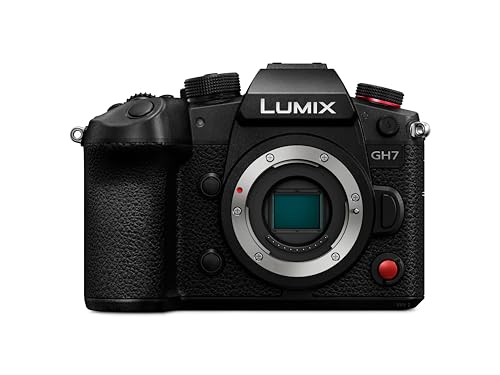
- 25.2MP Micro Four Thirds sensor
- 75 fps burst
- 5K video, 4K 120p
- 7.5-stop stabilization